
AI Agents for Small Businesses: A Practical 2026 Guide

AI agents for small businesses are software systems that can interpret a goal, decide what steps to take, use approved tools and complete multi-step work with limited human intervention. The strongest use cases are narrow, repetitive workflows with clear rules—such as lead qualification, appointment follow-up, support triage, document handling and reporting.
This guide explains where AI agents create real business value, how they differ from chatbots and traditional automation, what affects implementation cost, and how to introduce them without giving up human control.
What is an AI agent?
An AI agent is a system designed to pursue a defined objective. It can receive information, reason about the next step, call approved tools—such as a CRM, calendar or help desk—and evaluate whether the task is complete. Google Cloud’s overview of AI agents describes the same core pattern: reasoning, planning, tool use and action.
The difference between three commonly confused technologies is useful:
- Traditional automation follows fixed triggers and rules: when A happens, do B.
- An AI chatbot mainly holds a conversation and generates a response.
- An AI agent can select and sequence actions to achieve a goal within defined limits.
These approaches can work together. A customer may speak to a chatbot, while an agent checks order data, updates a support ticket and schedules a follow-up behind the scenes.
Key takeaways
- Start with one frequent, measurable and low-risk workflow.
- Give the agent only the data and permissions it needs.
- Keep human approval for payments, deletions, sensitive decisions and important customer promises.
- Measure time saved, response speed, completion rate, errors and customer outcomes.
- Treat an agent as an operational system that needs an owner, monitoring and periodic improvement.
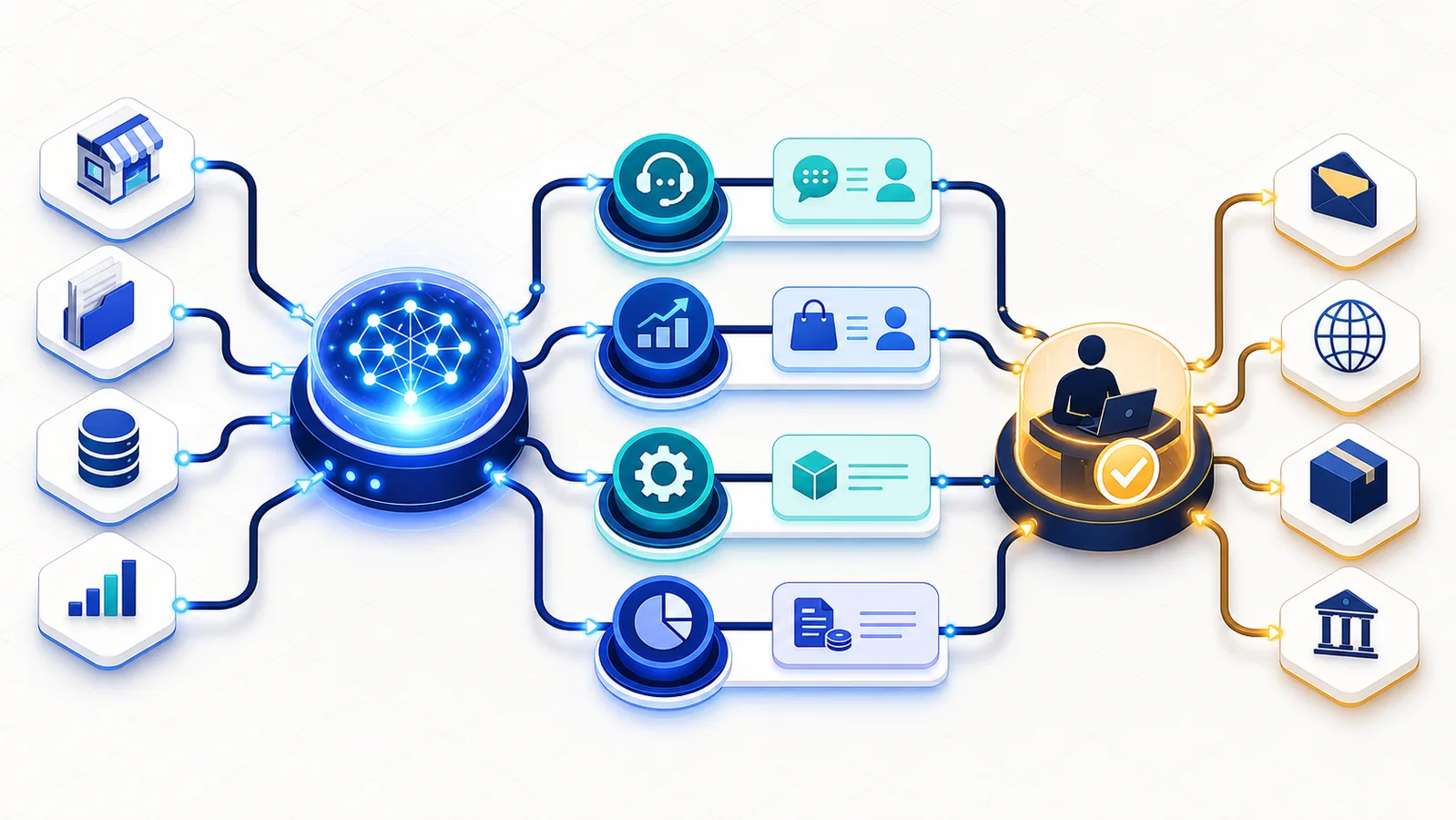
7 practical AI agent use cases for small businesses
1. Lead qualification and routing
An agent can review a website enquiry, identify the requested service, check whether key information is missing, assign a priority and route the lead to the right person. It can also prepare a suggested reply for human approval. This reduces the delay between an enquiry and a useful response without pretending every prospect is the same.
2. Customer support triage
A support agent can classify incoming messages, retrieve relevant account or order information, recommend a knowledge-base answer and escalate urgent or uncertain cases. The aim is not to remove people from customer service; it is to give them better context and a cleaner queue.
3. Appointment scheduling and follow-up
An agent can coordinate calendars, offer suitable times, confirm a booking, send reminders and follow up after a missed appointment. Clear rules should govern time zones, rescheduling windows and when a team member must take over.
4. Sales administration
Sales teams often lose time copying meeting notes into a CRM, preparing follow-up tasks and assembling standard proposal sections. An agent can draft these updates from approved source material while leaving pricing, scope and final commitments to an authorised employee.
5. Invoice and document processing
For consistent documents, an agent can extract fields, validate them against business rules and send exceptions for review. It can reduce manual re-entry, but financial approval and unusual transactions should remain under human control.
6. Marketing research and content repurposing
An agent can collect approved inputs, organise customer questions, turn a webinar into draft social posts and prepare a content brief. Brand, factual and legal review are still essential before anything is published.
7. KPI monitoring and reporting
An agent can pull data from connected systems, flag unusual changes and prepare a plain-language weekly summary. The most useful setup links every alert to a defined action rather than producing another dashboard nobody uses.
Is your business ready for an AI agent?
A promising first process usually has most of these characteristics:
- The work happens frequently and follows a recognisable pattern.
- Inputs are already digital, accessible and reasonably clean.
- Success can be defined—for example, a correctly routed lead or a completed booking.
- Exceptions can be sent to a named person.
- The business can control which systems, records and actions the agent may access.
If the underlying process changes every week, ownership is unclear or the data is unreliable, fix those foundations first. Automating confusion usually makes it move faster.
What determines the cost of an AI agent?
There is no responsible one-price answer. The investment depends on process complexity, the number and quality of integrations, expected usage, data preparation, security requirements, testing, human-review steps and ongoing monitoring.
A useful business case compares the full cost with the current baseline: staff time, delays, missed opportunities, error correction and customer impact. Begin with a contained pilot so you can test the assumptions before expanding.
A 6-step implementation roadmap
- Map the current process. Document the trigger, inputs, decisions, systems, outputs and common exceptions.
- Choose a high-value, low-risk task. Prefer work that is frequent, easy to measure and reversible.
- Define permissions and escalation. State what the agent may read, create or change—and what always requires approval.
- Connect trusted systems and data. Use approved sources, clear access controls and reliable integration points.
- Pilot with human review. Run real cases in a controlled environment, record failures and improve the instructions and workflow.
- Measure and improve. Review quality, completion rate, time saved, escalations, customer impact and operating cost.
AI agent risks and essential guardrails
AI agents can make mistakes, act on incomplete information or expose data when permissions are too broad. Practical safeguards include least-privilege access, approved data sources, action logs, test environments, spending limits and human approval for high-impact actions.
The NIST AI Risk Management Framework is a useful reference for managing AI risk. Its govern, map, measure and manage approach reinforces an important point: responsible deployment is an ongoing operating discipline, not a one-time checklist.
Frequently asked questions
Are AI agents the same as chatbots?
No. A chatbot is primarily a conversational interface. An AI agent may use conversation, but it can also plan steps, call approved tools and take actions in connected systems.
Does a small business need an in-house technical team?
Not necessarily. A business still needs a process owner who understands the work and can approve rules, access and outcomes. A specialist partner can design integrations and controls, but accountability should remain inside the business.
What should never be fully autonomous?
Keep meaningful human approval around payments, account deletion, legal or medical decisions, hiring decisions, sensitive customer commitments and actions that are difficult to reverse.
How quickly can an AI agent create value?
That depends on process clarity, data quality and integration complexity. A narrow pilot can validate value much faster than a company-wide programme, but it should be judged on measured outcomes rather than a promised timeline.
Where should we start?
Start with one repetitive process that has a clear owner, measurable outcome and safe escalation path. Afritech Global’s AI and automation services help businesses identify, design and implement practical use cases.
Turn one repetitive workflow into a measurable pilot
The best AI agent strategy starts with the work, not the technology. Map the process, define the guardrails and prove the outcome on a focused use case. Book a strategy call with Afritech Global to evaluate where an AI agent could save time or improve service in your business.

Keep reading
More insights for your business.
 Digital Approval Workflows: Replace Email Chasing Without Losing Control
A practical framework for replacing approval-by-email with clear ownership, useful reminders, audit trails and controlled exception handling.
Read the article
Digital Approval Workflows: Replace Email Chasing Without Losing Control
A practical framework for replacing approval-by-email with clear ownership, useful reminders, audit trails and controlled exception handling.
Read the article
 AI Agent Evaluation: How to Test Reliability Before Deployment
A practical evaluation framework for testing task success, evidence, safety, permissions, cost and escalation before an AI agent goes live.
Read the article
AI Agent Evaluation: How to Test Reliability Before Deployment
A practical evaluation framework for testing task success, evidence, safety, permissions, cost and escalation before an AI agent goes live.
Read the article
 AI Readiness Assessment for SMEs: 12 Questions Before You Invest
Twelve practical questions for assessing whether an SME has the problem clarity, data, controls and team capacity needed for an AI initiative.
Read the article
AI Readiness Assessment for SMEs: 12 Questions Before You Invest
Twelve practical questions for assessing whether an SME has the problem clarity, data, controls and team capacity needed for an AI initiative.
Read the article
Ready to put AI to work in your business?
Book a free strategy call and leave with a concrete plan, whether we work together or not.